
Technician Alex arrived the same day, which was incredibly convenient. He quickly diagnosed the problem, and to my relief, had the necessary part right in his truck. The repair was completed on the spot, and my fridge was cooling perfectly again by the end of the day. The pricing was fair and affordable.I'm very pleased with the service from Refrigerator and Appliance Repair in Escondido. Alex was a true professional. Highly recommend them for prompt and reliable appliance repair
Wine Fridge & Wine Cooler Repair in Escondido
A wine fridge around here isn't fancy gear. It's the 24-bottle NewAir on the garage workbench, the under-counter Kalamera that arrived with the kitchen remodel, the Frigidaire beverage center keeping reds away from the stove.
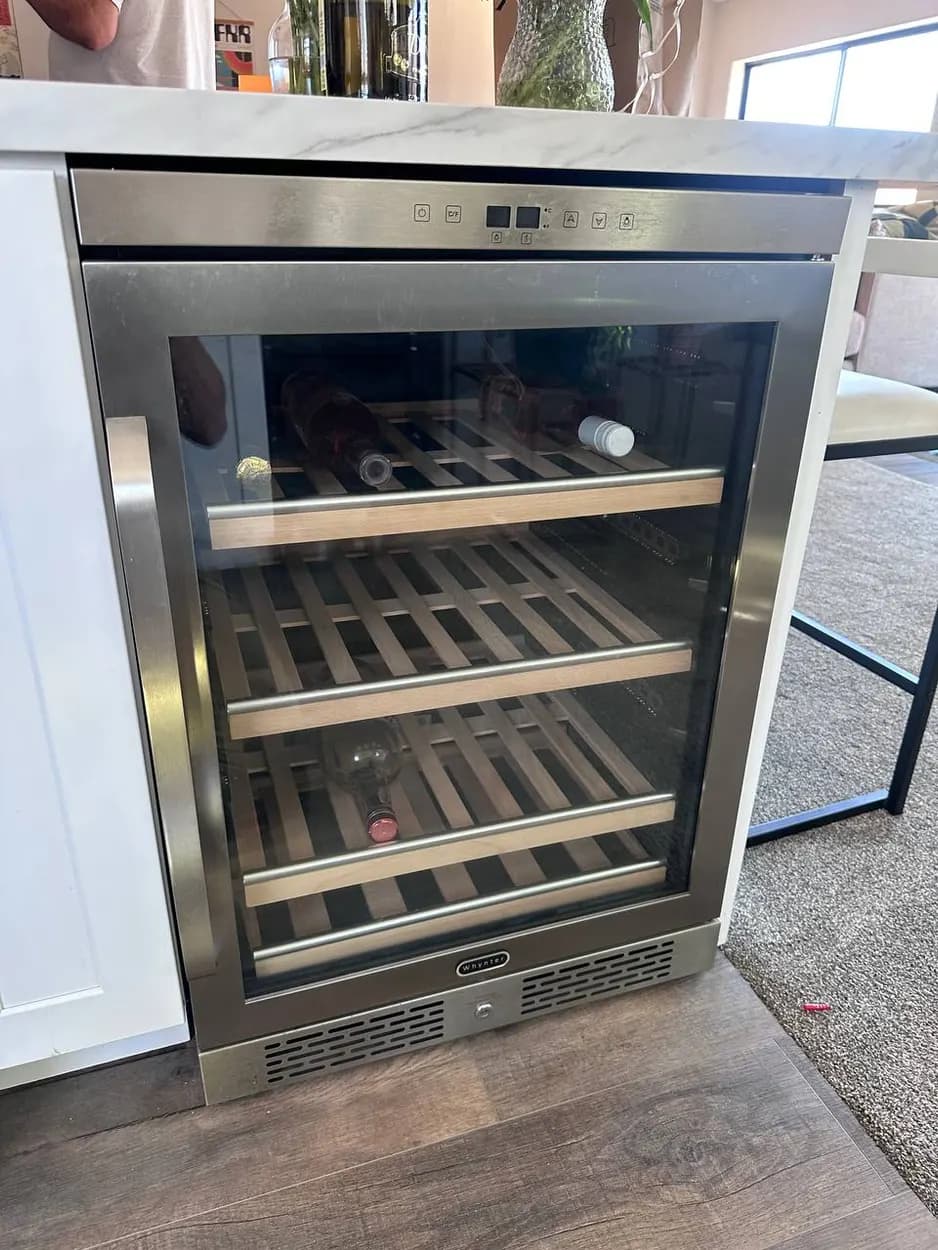
Six Wine Fridge Symptoms We See Every Week
With Temecula's tasting rooms a short run up the 15, plenty of North County households end up holding a case or two — and a cabinet that quietly climbs from 55°F to 68°F can waste it in silence. Refrigerator & Appliance Repair – Escondido services wine coolers and wine fridges across Escondido and the inland towns around it. Family-run since 2018, insured, and reachable daily from 7am to 9pm. A diagnostic visit runs $80, and we knock that $80 off the repair price if you go ahead. Call (858) 886-8646 — a cooler losing its cold can usually be seen the same day. On this page: six symptoms we meet weekly, the one question that decides every wine fridge repair — thermoelectric or compressor — and published prices for the common fixes.
Nothing cold behind the glass
When a wine fridge stops cooling outright, the suspect list depends on the machine inside. On compressor models we check the start relay, the condenser fan, and a coil wearing a coat of garage dust before anyone mentions refrigerant. On thermoelectric models the usual culprits are an aged Peltier plate or a heat-sink fan that quit spinning, leaving the module to cook in its own heat. Either way, the visit starts with a thermometer in the cabinet, not a guess at the door.
A setpoint the cabinet ignores
You set 55°F; the readout wanders to 61°F, dips to 58°F, then floats back up. Drift like that usually traces to a temperature sensor reading wrong, a control board losing the plot, or a door seal feeding in warm air around the clock. Interior vents blocked by a bottle pushed too deep can do it too — the cheapest fix on this page. On dual-zone cabinets, two readings that slowly stop agreeing point to one zone's own hardware, which gets its own section below. Steady storage is this appliance's entire job description, so we chase the cause instead of nudging the dial.
Louder than it used to be
A healthy compressor model hums quietly, clicks, and rests. A rattle, a buzz that builds through the evening, or a vibration you can feel through the cabinet wall usually means fan bearings wearing out or compressor mounts going soft. You don't need a cellar to care: constant shaking stirs sediment and is hard on any bottle you meant to keep past the holidays. Noise is also an early warning — a part announcing itself before it dies. Catching it at the rattle stage costs less than catching it at the warm stage.
Fog or droplets on the glass door
Moisture on the inside of the glass points to a gasket letting humid air leak past, or — on some models — a failed door-frame heater that's supposed to keep the pane above dew point. Droplets on the outside show up on damp mornings and usually mean nothing. Persistent inside fog matters: it drips onto labels, invites mildew, and tells you the cooler is fighting outside air every hour. Inside fog is the seal talking, and a new gasket is one of the smaller repairs we do.
The light or display went dark
A dead readout with the hum still running is usually the display board or its ribbon cable. Everything dark means the power supply, the outlet itself, or — common with garage units — a tripped GFCI. Interior lights tend to fail at the door switch or the LED strip rather than the bulb. We trace power from the wall inward and only replace a board when the meter convicts it.
Ice creeping up the back wall
On many freestanding units the back wall is the cold plate, and a thin film of frost mid-cycle can be normal. A growing ridge of ice is not. It means the unit is running far more than designed — a leaking seal, a sensor reading warmer than reality, or a setpoint cranked low to fight a hot room. Ice is insulation, so the thicker it builds, the warmer the bottles sit, which drives the machine even harder. We melt the wall clear, then fix whatever told the cooler to never rest.
Thermoelectric or Compressor? The First Question We Answer
Two very different machines wear the same black cabinet. One cools with a compressor, like a scaled-down refrigerator. The other cools with a thermoelectric (Peltier) plate — a solid-state device with no refrigerant in it at all. The parts, the price, and even whether a repair makes sense all hinge on which one is sitting in front of us, so it's the first thing we establish, often right on the phone.
Weigh it, listen for the click
Three living-room tests sort nearly every unit. Weight first: thermoelectric coolers are light — a 12-bottle cabinet lifts with one hand — while a compressor model of the same size feels like a small fridge, because it is one. Sound second: a compressor cycles, so you'll hear the hum start, run a while, click off, and rest; a thermoelectric unit gives a constant whisper, never a click. Vibration third: rest a palm on the side panel — a running compressor passes along a faint tremor, while a Peltier unit sits almost perfectly still, which is exactly why people buy them. Still unsure? The label settles it: thermoelectric units list a recommended room temperature, and almost any cabinet over about 32 bottles is compressor-cooled.
The 20-degree ceiling: why Peltier units lose to Escondido summers
A Peltier plate doesn't generate cold. It pumps heat from one face to the other, and most units run out of pumping power somewhere around 15–20°F under the air surrounding them. In a 75°F dining room that leaves 55°F within easy reach. In an Escondido garage in August — where the air inside routinely passes 95°F by mid-afternoon — the very best that cabinet will produce is somewhere in the mid-70s. The bottles warm up, the owner calls us, and the honest answer is that nothing in the unit is broken. It's the design limit, not a defect, and we'd rather explain that on the phone than collect $80 to repeat it in your driveway. At Refrigerator and Appliance Repair – Escondido the line is simple: we fix machines; we can't repair the weather. If a thermoelectric cooler lives somewhere hot, the cure is placement, not parts — move it indoors for the hot months, or step up to a compressor model, which holds its setpoint whatever the thermometer outside says.
What we repair on each type
On a thermoelectric unit the serviceable parts are the Peltier module itself, the heat-sink fans on either side of it, the power supply, and the thermostat. Modules and fans bolt on, so the labor is straightforward — the only real question is whether the cabinet's value justifies the part, and we'll run that math with you before the van moves. On a compressor unit the menu reads like a refrigerator's: start relay, condenser and evaporator fans, temperature sensor, door gasket, control board, and the sealed refrigerant circuit at the expensive end. Sealed-system jobs differ too widely between models for a list price, so that one is always a written quote after testing.
Dual zone: the second zone is its own small machine
A dual-zone cabinet keeps reds and whites apart by giving the second compartment its own temperature sensor and its own air damper — on a handful of designs, its own Peltier module. That's good news when one side fails. If the white-wine side climbs while the red side holds steady, suspicion falls on the parts only that side uses, not on the compressor both sides share. We test each compartment against its own numbers and replace the single component that quit. The bill usually lands at the small end of the price list, and the healthy zone keeps working the whole time.
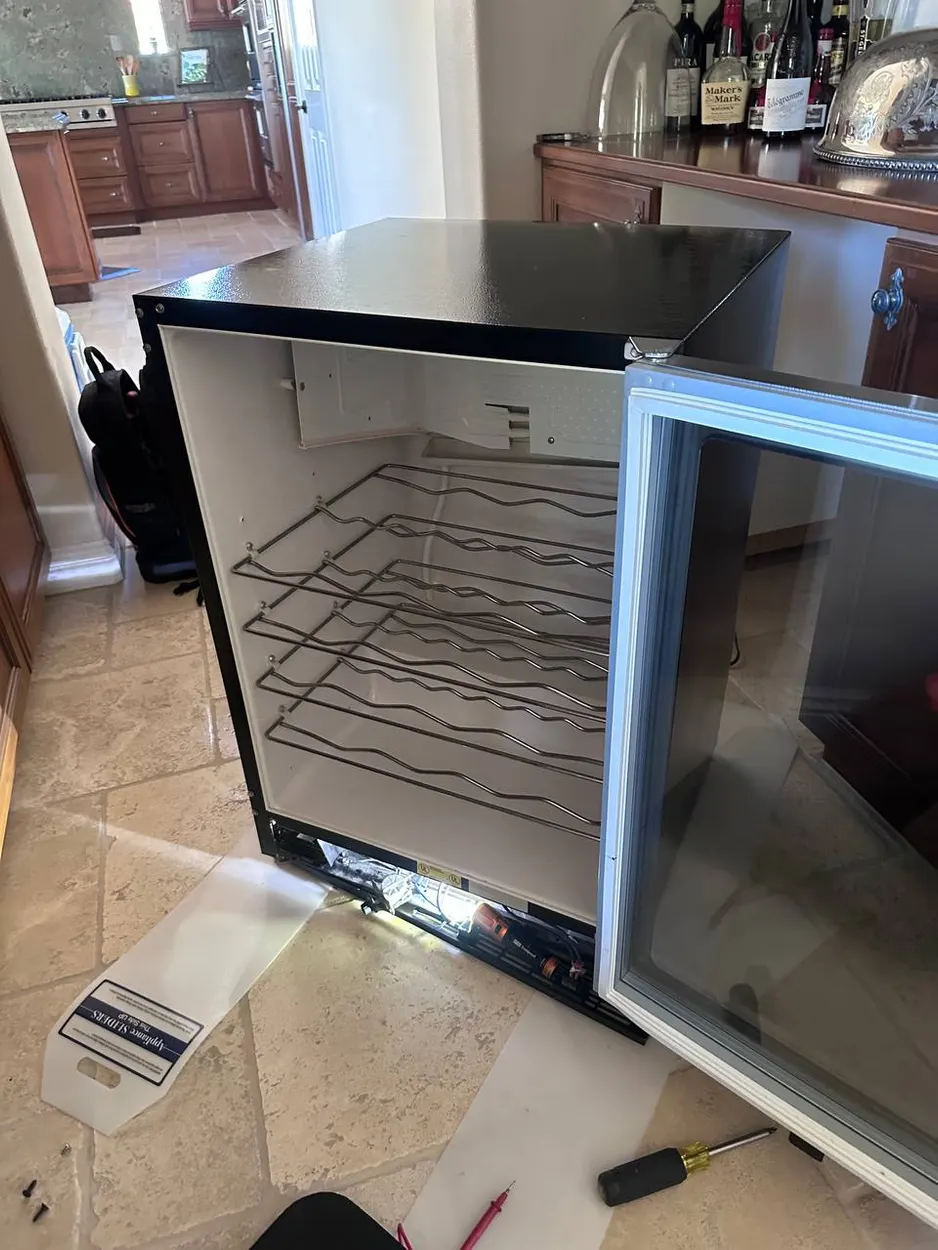
The Brands in North County Garages and Kitchens
We work on the wine fridges people around here actually own, not showroom exotics. NewAir and Kalamera lead the freestanding market — Kalamera's compressor under-counter units turn up after kitchen remodels all over Escondido, and NewAir sells both cooling technologies, so run the type test above before you call. Danby's smaller cabinets are usually thermoelectric and follow the module-and-fan repair path. Frigidaire and GE beverage centers and wine chillers are compressor machines through and through, and they draw on the same part families we already carry for their refrigerators. Whirlpool wine and beverage units, including the ones badged for big-box stores, follow the same logic.
One quiet advantage in this segment: a surprising number of these cabinets come off shared production lines, so fans, sensors, and gaskets often cross-reference between brands. Give us the brand and the bottle count when you book — those two facts tell us the cooling type, the likely fault, and which parts belong on the truck.
What Wine Cooler Repair Costs in Escondido
The ranges below match what we charge across inland North County and line up with 2025–2026 national repair-cost surveys for wine and beverage coolers. Two ground rules first. Our minimum for any completed repair is $250 — that floor covers a skilled tech's time, a quality part, and the 90-day labor warranty standing behind both. And the $80 diagnostic isn't stacked on top: approve the work and we knock the $80 off the repair price.
| Diagnostic visit | $80 — deducted from the repair price you approve |
| Thermoelectric (Peltier) module with heat-sink fan | $250–$390 |
| Cooling fan assembly | $250–$350 |
| Thermostat or temperature sensor | $250–$370 |
| Door seal (gasket) | $250–$340 |
| Compressor & sealed-system work | written quote after the diagnostic |
| Evaporator / circulation fan motor | $250–$400 |
| Control board replacement | from $300, firm figure after diagnosis |
| Interior LED lighting & switch repair | from $250 |
| Door hinge & reversible-door alignment | $250–$340 |
These figures are typical ranges for reference only — the exact price comes after the $80 diagnostic, before any work begins, and the price you approve is the price you pay.
There is one repair we'll talk you out of: the small, cheap thermoelectric cabinet. A 12-bottle unit that sold for $140 can't clear a $250 repair bill no matter how well we work — the same arithmetic that retires most bargain microwaves. Tell us the brand and size when you call; if the math fails, we'll say so for free. Larger thermoelectric cabinets and nearly every compressor unit sit on the other side of that line, where repair wins comfortably.
Booking a Wine Cooler Visit
Ring (858) 886-8646 or book online — someone answers every day between 7am and 9pm. Tell us the brand, roughly how many bottles the cabinet holds, and what it's doing. Those details let us load the right parts and tell you honestly whether the trip is worth your money. A cooler drifting toward room temperature gets bumped up the day's route when we can manage it. You'll get an arrival window and a text when the technician heads out.
The visit opens with the $80 diagnostic; approve the repair and we subtract the $80 from the final price. If another appliance is acting up, we'll diagnose it during the same stop for $40 instead of a second $80. Door gaskets, fans, sensors, and relays for the common cabinets travel on the van. Peltier modules are matched to the exact model, so when one needs ordering it typically lands within a few days. Every job we finish is backed by a 90-day labor warranty — same fault, same cabinet, and the follow-up visit costs nothing. The rest of what we fix, from refrigerators to dryers, is laid out on our services page.
Escondido Reviews, Unedited
The three reviews below come straight from our Google profile, word for word. They aren't all wine-cooler jobs — most of this valley's calls are refrigerators and laundry — but they show what carries over to every visit: same-day scheduling when the route allows, a diagnosis explained in plain terms, and a price agreed before any work begins.
Amazing and quick job! Washing machine was having problems and he knew how to fix right away! 100% recommend
Yuri came out to fix my non-heating old whirlpool dryer.I took it apart and tried fixing it myself but with no luck. I didn't want to keep throwing money at it.I called one place and they told me they charge $130 just to come look at my dryer. I called this place and they gave me a quote of $80 for diagnostic and possible repair. I thought that was pretty fair. Also I had an appointment the same day I called.Once Yuri showed up, I told him everything I looked for. He took bout 10 minutes to figure out that my gas coils broke. He told me his price, but he told me that i could probably do it myself and he could just charge me the diagnostic fee. I got too many projects to work on so I asked him to fix it. He fixed it in 10 minutes, it probably would have taken me a couple hours because im always scared of breaking things.Fairly priced, fast, and honest
Frequently Asked Questions
How much does wine cooler repair cost in Escondido?
For most jobs, between $250 and $390. Cooling fan assemblies run $250–$350, thermostats and sensors $250–$370, door seals $250–$340, and a thermoelectric module with its fan $250–$390. Compressor and sealed-system work gets a written quote after testing, because models vary too widely for one honest flat number. The $80 diagnostic isn't an extra charge — approve the repair and we subtract it from the final price.
My garage wine fridge won't hold 55°F in summer — is it broken?
If it's thermoelectric, probably not. A Peltier system tops out around 20°F below the surrounding air, so a garage sitting at 95°F caps the cabinet in the mid-70s no matter what the dial promises. The cure is placement or an upgrade to a compressor model — and we'll confirm which type you own over the phone for free. If a compressor unit can't hold 55°F out there, something genuinely failed, and that one is worth the visit.
Can I just keep wine in the regular refrigerator?
For a few weeks, honestly, yes — whites and sparkling wine come to no harm. As long-term storage it works against you: a kitchen fridge runs 35–38°F, colder than wine wants, and its air is very dry, which shrinks corks over the months; the door also swings open dozens of times a day. Everyday bottles won't notice. Anything you plan to keep a year or more does better at a steady 55°F. And if the kitchen fridge itself is the sick one, that's our refrigerator repair page.
Is a thermoelectric wine cooler worth repairing?
Size decides — the rule Refrigerator and Appliance Repair – Escondido quotes on the phone: on cabinets of roughly 24 bottles and up, a new Peltier module and fan at $250–$390 usually beats replacing a $500–$700 unit. On a small 12-bottle cooler that sold for under $200, the repair can't win, and we'll say so before the van ever leaves the shop. The answer changes with the unit, which is exactly why we ask for brand and size when you call.
One zone of my dual-zone cooler went warm — is that a big repair?
Usually one of the smaller ones. Each zone runs its own temperature sensor and air damper, so a single warm compartment almost always traces back to that zone's hardware rather than the compressor both zones share. We test the compartments separately and replace the one failed part. Expect sensor-or-damper money — the $250–$370 band — not compressor money.
Can you come out today?
Often, yes. We schedule seven days a week, 7am to 9pm, across Escondido and the surrounding inland towns. A wine fridge climbing toward room temperature gets priority routing the same way a warm refrigerator does, since the contents won't wait. Call (858) 886-8646 in the morning and same-day is the usual outcome; call in the evening and you're typically first up tomorrow.
Why is ice growing on the back wall of my wine cooler?
Because the unit is running far more than it should. The usual drivers are a door gasket leaking humid air, a sensor reading warmer than reality, or a setpoint cranked low to fight a hot room. Frost insulates the cooling plate, so the cabinet actually gets warmer as the ice thickens. We thaw the wall, then fix the part that caused the overrun — defrosting alone just restarts the clock.
What does your warranty cover on wine cooler work?
Ninety days of labor on every repair we complete. If the same fault returns inside that window, the return visit costs nothing and you don't pay a diagnostic again. Parts carry their manufacturer's coverage on top of that.
Brands We Repair
From Samsung and Whirlpool to Sub-Zero and Wolf — we stock parts for every major brand and fix the rest too. Tap yours for repair details and pricing.
No call center, no subcontractors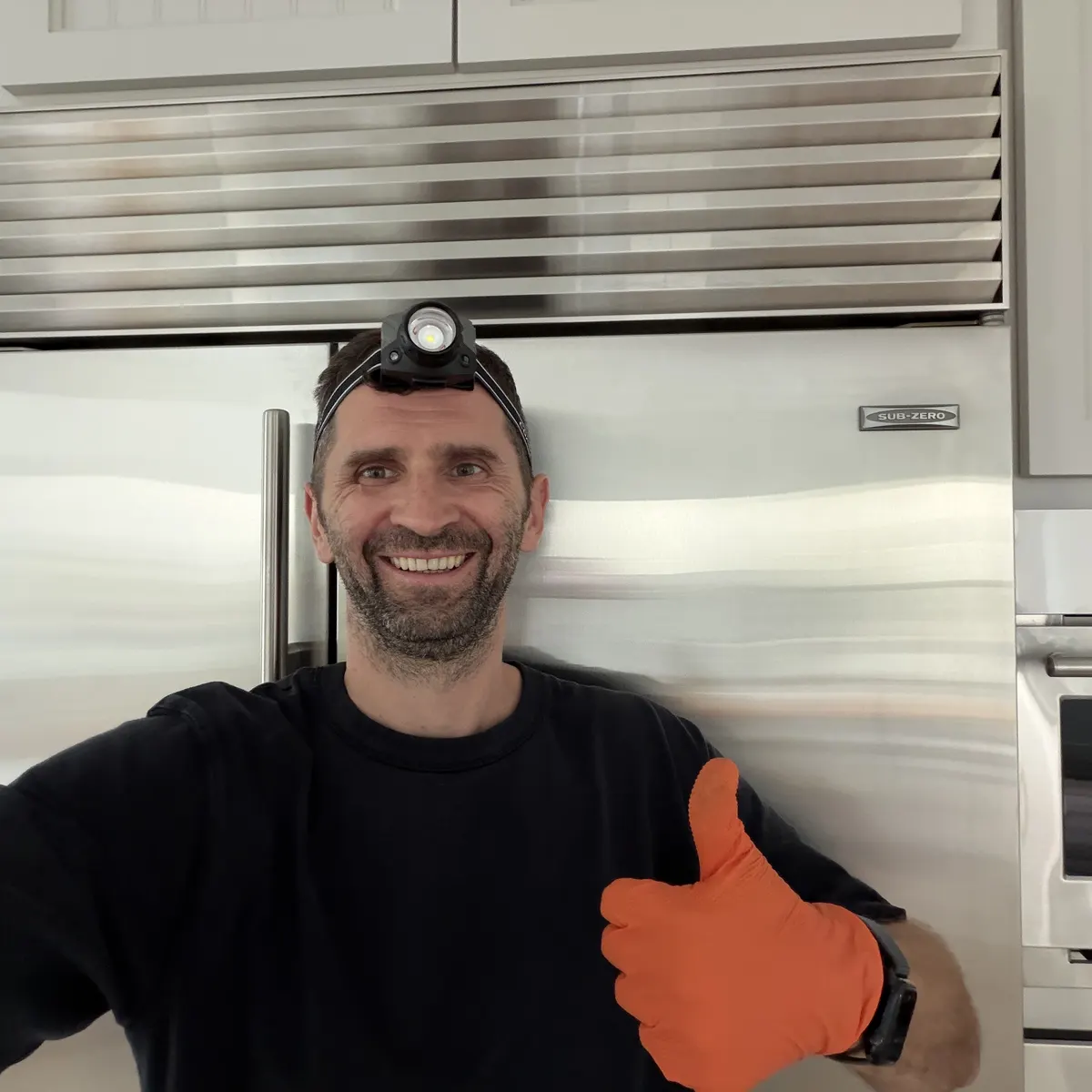


The technicians who show up
Yurii
RefrigerationAndrew
LaundryIgor
KitchenReady When Your Appliance Isn't
Call now or book online — same-day slots across Escondido and North County, 7am–9pm daily. The $80 diagnostic comes off the bill when you approve the repair.