
We don't live in Escondido, and finding a reliable appliance repair company to handle everything remotely has always been a challenge. Working with Refrigerator & Appliance Repair – Escondido was an absolute pleasure — everything went smoothly and professionally. Our refrigerator was fixed the same day, the price was fair, and technician Alex did an excellent job. Highly recommend this team!
Sub-Zero Refrigerator & Wine Storage Repair in Escondido
Sub-Zero builds refrigerators that outlive the kitchens around them — but they still break. When yours does, Refrigerator & Appliance Repair – Escondido picks up at (858) 886-8646 and treats it the way we treat any warm refrigerator in Escondido: as a priority.
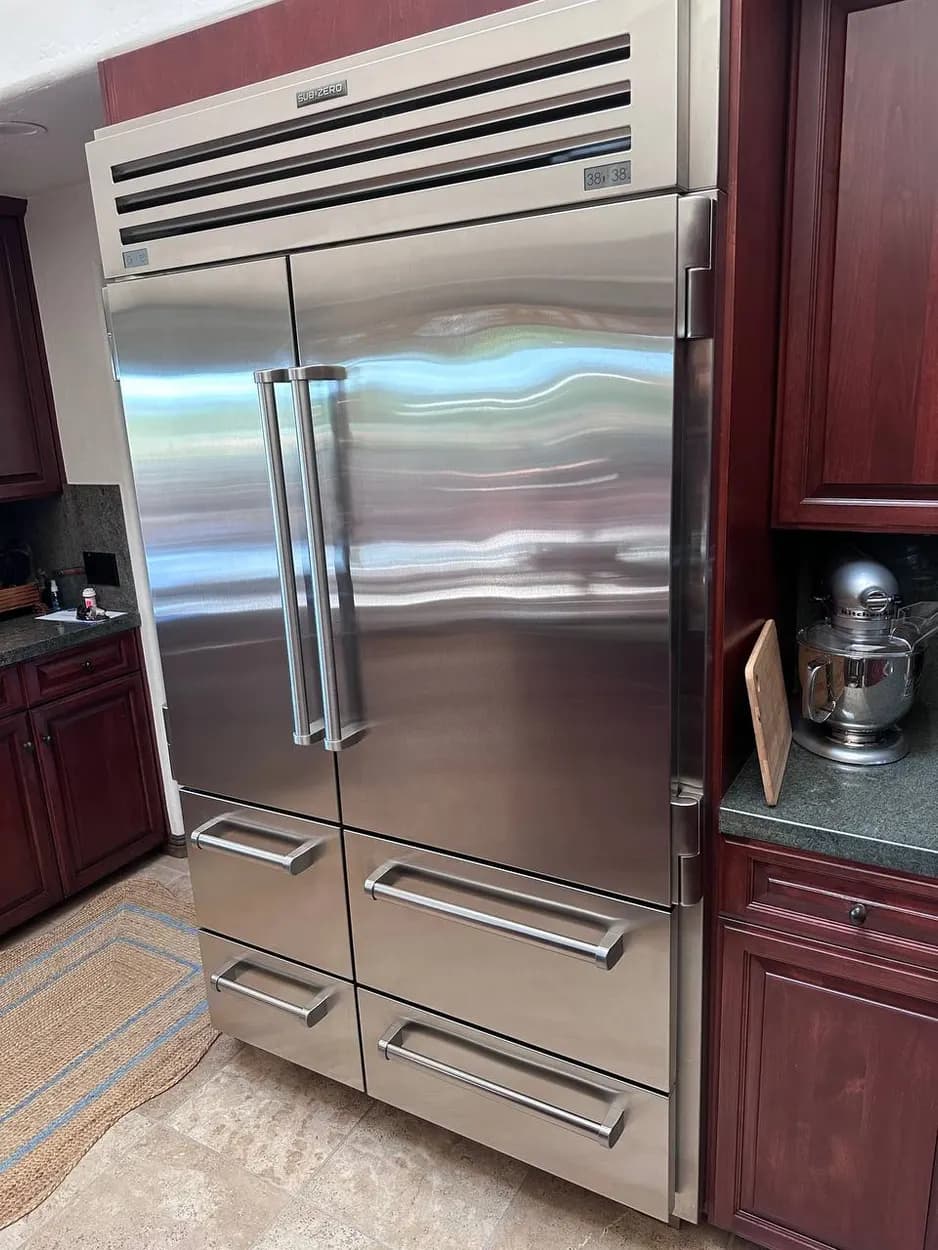
Two Cooling Systems in One Cabinet: Why Dual Refrigeration Changes the Repair
The $80 diagnostic is the same one every customer pays, it counts toward the repair, and the visit ends with a price in writing before any work begins. We have run Sub-Zero cooling calls across Escondido (92025, 92026), San Marcos, Poway, and Rancho Bernardo since 2018 — family-owned, insured, open daily 7am to 9pm, with a 90-day labor warranty on every job. The machines on this page — built-in refrigerators, undercounter drawers, and 400-series wine storage — cost serious money new. That is exactly why repairing them almost always beats replacing them, and why it helps to know a local shop that works on them without drama.
Open the grille on a Sub-Zero built-in and you find something most refrigerators don't have: two of everything. The refrigerator compartment and the freezer each run their own compressor, their own evaporator, and their own controls. Sub-Zero calls this dual refrigeration. It is why lettuce lasts longer in these boxes and ice never picks up food smells — the two compartments never share air or refrigerant.
It is also why a Sub-Zero gets diagnosed differently. A standard refrigerator is one cooling system with a damper splitting the cold; when it fails, everything warms up together. A Sub-Zero fails in halves. The freezer keeps working while the fridge side gives up, or the other way around — and that pattern is information. If your freezer holds zero while the fresh-food side drifts past 45°F, the problem lives in one circuit, and we test that circuit's compressor, fan, and sensor on their own. Internet checklists written for single-compressor machines send Sub-Zero owners chasing the wrong parts. Refrigerator & Appliance Repair – Escondido diagnoses each system separately, because that is how the machine was built. The general playbook for a fridge that quit cooling lives on our refrigerator repair page; this page covers what Sub-Zero adds to it.
The condenser gets checked first. Before we condemn any part, we inspect the condenser coil behind the top grille. A Sub-Zero pulls its cooling air through that coil around the clock, and the coil collects dust, lint, and pet hair the whole time. Inland Escondido is dusty country, and we find coils packed so tight the unit can't shed heat — both compartments struggle, both compressors run hot, and newer models flash a service light asking you to vacuum the condenser. A deep condenser cleaning is built into every Sub-Zero visit we make. Some days, the cleaning is the whole repair, and the bill stays small.
Door seals do more work than people think. Sub-Zero doors close against magnetic gaskets, and on a built-in carrying a heavy custom panel, those gaskets earn their living. Try the dollar-bill test: shut the door on a bill and pull. If it slides out with no grip, the seal has quit, warm air is leaking in around the clock, and the compressor on that side is paying for it. A fresh OEM gasket is one of the more affordable Sub-Zero repairs we do and one of the most common. We replace them per door, and the temperature recovery is usually obvious by the next morning.
From the Classic 500s to Today's Built-Ins: The Sub-Zero Units We Repair
North County kitchens have been getting Sub-Zeros since the 1980s, so we meet every generation of the brand.
BI-series built-ins. The current full-size family — over-and-under units like the BI-36U, side-by-sides like the BI-42S, and the 48-inch boxes with through-door ice. These carry modern electronic controls, report faults as codes on the display, and wear custom panels. Most of our Sub-Zero work happens here.
Classic 500 series. The tanks of the brand. Units like the 501R, 532, 550, and 561 went into local kitchens in the late '80s and '90s, and plenty are still running. Their controls are simpler — mechanical cold controls instead of circuit boards — and parts for most repairs remain available. We stay honest about the limits: a 35-year-old sealed system that fails is a bigger conversation, and we'll have it with real numbers on the table.
600 and 700 series. The bridge generations. The 600s are full-size built-ins such as the 650 and 690; the 700s are integrated models that hide flush in the cabinetry and report trouble as EC codes we read on arrival.
400-series wine storage. The 424, 427, and 430 hold two independent temperature zones in one cabinet — the dual-refrigeration idea applied to wine. When one zone drifts, it is usually a thermistor or a door seal, not a dying unit. We service these alongside our regular wine cooler work.
Undercounter and drawer units. UC refrigerator drawers, beverage centers, and ice machines tucked under the island. Small boxes, the same engineering, the same $80 diagnostic.
One practical note about built-ins: these machines are screwed, trimmed, and paneled into the cabinetry. Part of knowing Sub-Zero is knowing how to service one in place — without pulling the unit unless the repair truly requires it, and without leaving a mark on the woodwork when it does.
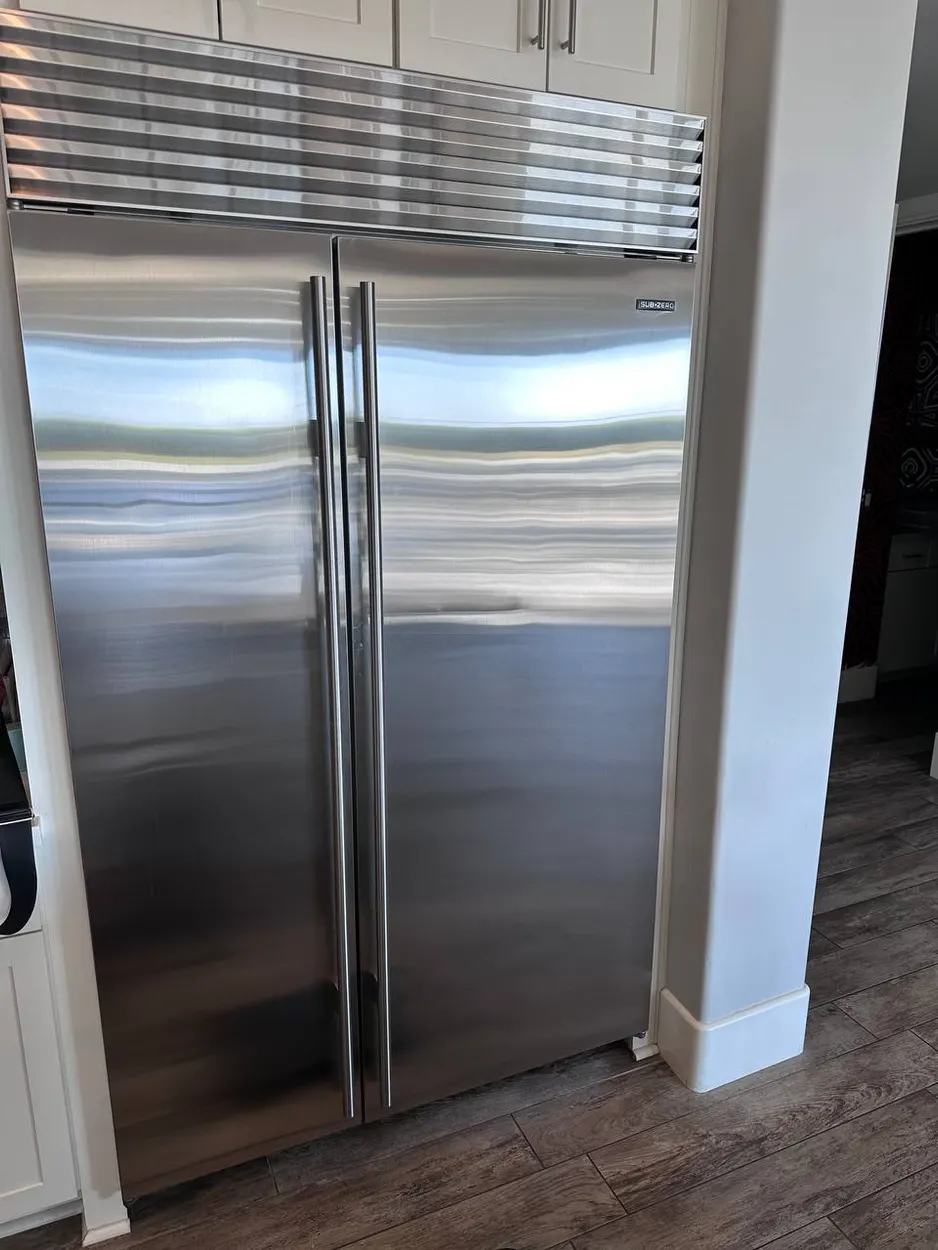
What Actually Goes Wrong: The Sub-Zero Calls We Run
One side warm, the other side fine. The classic Sub-Zero complaint, and dual refrigeration is why it looks so strange. The warm side has its own small problem — a packed condenser starving the system of airflow, an evaporator fan that stopped moving cold air, a sensor reading wrong, or a tired compressor on that circuit alone. We check them in that order, because that is the order of likelihood and of cost. The dead compressor is the least common of the four, and owners are usually relieved to hear it.
A sheet of ice on the freezer's back wall. That is a defrost failure on the freezer circuit — the heater or its terminator. The evaporator slowly turns into an ice block, airflow dies, and temperatures climb even though the compressor never stops running. Melting it out buys you days; replacing the failed defrost part ends it. The same fault shows up in stand-alone units too — see our freezer repair page.
The service light won't turn off. Plenty of owners vacuum the condenser and the light stays on. Sometimes the coil needs a deeper cleaning than a household vacuum can manage. Sometimes the condenser fan itself has quit, so airflow stays poor no matter how clean the coil is. And on some series the indicator wants a reset sequence after the cleaning. We sort out which one it is in a single visit.
Ice maker stopped — or the cubes turned small and cloudy. No ice at all usually traces to a frozen fill tube, a failed water inlet valve, or the ice maker module itself. Small, cloudy, or hollow cubes point upstream: weak water flow from a clogged filter or a half-closed supply valve. The ice maker is often the messenger, not the fault. More on that logic on our ice maker page.
EC codes on the display. The 600/700 generations and the BI series report faults as EC codes. In our experience the code most often names a thermistor that drifted out of range — a sensor swap, not a control board. We test the sensor before anyone pays board money.
The door won't swing shut on its own. Sub-Zero hinges are built to self-close, and they carry real weight once a custom panel is bolted on. A door that hangs open or sags usually means the hinge cartridge has worn — a mechanical repair, with parts ordered by model.
A wine unit drifting off temperature. On the 400 series, one warm zone is typically a thermistor or a gasket; both zones warming together points to condenser airflow. Because wine sits untouched for years, owners often catch the drift late. If your display and a shelf thermometer disagree, call before the collection notices.
Water pooling under the unit, a buzz from the compressor compartment, frost creeping around the door frame — the pattern always points somewhere specific. Tell us the symptom when you call, and we usually arrive already knowing the three most likely causes.
Sub-Zero Repair Costs in Escondido
| Diagnostic visit — applied to the repair | $80 |
| Second appliance diagnosed on the same visit | $40 |
| Door gasket replacement, per door (OEM seal) | $250–$450 |
| Evaporator or condenser fan motor | $280–$550 |
| Temperature sensor / thermistor (EC-code calls) | $250–$420 |
| Ice maker repair or module replacement | $300–$560 |
| Deep condenser coil cleaning / service-light reset | from $250 |
| Defrost heater or defrost thermostat (freezer circuit) | $300–$560 |
| Self-close door hinge cartridge, per door | $300–$520 |
| Sealed system (compressor, evaporator, refrigerant) | Written quote after diagnosis |
These figures are typical ranges for reference only — the exact price comes after the $80 diagnostic, before any work begins, and the price you approve is the price you pay.
Sub-Zero Repair Prices in Escondido
Sub-Zero parts cost more than their mass-market equivalents — there is no way around that, and we won't pretend otherwise. A fan motor or gasket made for a built-in can run double or triple what the same part costs for a big-box refrigerator. Here is the other half of the truth: a new Sub-Zero runs roughly $9,000 to $20,000 installed, and the machine underneath is engineered to be serviced for twenty years or more. Against that, almost any repair is maintenance, not a loss. The parts cost more; the machine costs far more.
Most Sub-Zero repairs at Refrigerator & Appliance Repair – Escondido land between $250 and $560 — door gaskets and fan motors at the lower end, ice makers higher — and sealed-system work gets a written quote after the $80 diagnostic. The table below covers the jobs we price most often. Compressors, evaporators, and refrigerant leaks vary too much by model and by fault to carry a fair flat number, so on those you decide with the real figure in front of you. The diagnostic is credited toward whatever repair you approve. If something else in the kitchen is acting up, we will diagnose a second appliance on the same visit for $40.
A Family Shop for a Serious Refrigerator
There is a belief that a Sub-Zero needs a special hotline and a special invoice. It doesn't. It needs a technician who understands dual refrigeration, carries the right meters, and respects the cabinetry — and that describes our crew. Refrigerator & Appliance Repair – Escondido is a family business that has been repairing appliances in these neighborhoods since 2018. The technician who fixed your neighbor's Whirlpool yesterday can test a Sub-Zero circuit today, and the rules of the visit don't change: $80 diagnostic credited to the work, a written price before we touch a part, and a 90-day labor warranty after we leave.
We stock the universal consumables, but we won't pretend every Sub-Zero part rides in the van. Gaskets, hinge cartridges, and fan motors are model-specific, so many Sub-Zero repairs run as two visits — diagnose and order, then return and install. You hear the timeline before you commit, and the diagnostic fee doesn't double because we came twice.
A few ways to trim the bill: book online and take $20 off; seniors 65 and up and veterans get $20 off; so do first responders. We answer daily, 7am to 9pm, because refrigerators don't fail on a business schedule. And if the same kitchen holds a Wolf range, the same crew covers it — see our Wolf repair page or the full brand list.
Get Your Sub-Zero Looked At
A warm Sub-Zero doesn't fix itself, and waiting costs groceries — or a wine collection. Call (858) 886-8646 and tell us the series, the symptom, and any code on the display. Morning calls usually land a same-day visit anywhere from Escondido out to Rancho Bernardo. The diagnostic is $80, it counts toward the repair, and the price goes on paper before the work starts. Prefer to book online? That takes $20 off, and the calendar is open seven days a week.
What Neighbors Say
Our Whirlpool fridge in Valley Center was running but not cooling. Alex explained it was the compressor, ordered the part, and returned the next day to install it. He was on time both days and the repair cost was fair.
Andrew arrived within the window of time that we were told he would arrive. He texted when he was on his way and when he arrived. He came in and identified the problem and had the parts with him to make the repairs. He completed the job and cleaned up afterwards. He was courteous. It was a good experience and we would call them again if we have any appliances that needed repairs.
Sub-Zero Repair in Escondido: Your Questions, Our Answers
How much does Sub-Zero repair cost in Escondido?
Door gaskets run $250–$450 per door, fan motors $280–$550, temperature sensors $250–$420, and ice maker work $300–$560 at Refrigerator & Appliance Repair – Escondido. Sealed-system jobs — compressor, evaporator, refrigerant — get a written quote after diagnosis instead of a guess. The $80 diagnostic is credited toward whatever repair you approve, so the visit fee disappears into the fix.
Can you fix a Sub-Zero the same day in Escondido?
We can usually diagnose it the same day you call, especially on morning calls. Whether the fix finishes that visit depends on the part. Condenser cleanings, many fan and sensor repairs, and most no-cool first aid happen on the spot. Model-specific parts like gaskets and hinge cartridges typically need ordering, so those repairs wrap up on a short return trip — with no second diagnostic fee.
My Sub-Zero is flashing a service light or an EC code — is it serious?
Usually not. The vacuum-condenser light is a chore reminder, not a death notice — the coil needs cleaning so the unit can shed heat. EC codes on the 600/700 and BI series most often trace to a thermistor reading out of range, which means a sensor swap rather than a control board. Note the code, call (858) 886-8646, and we'll tell you what it points to before we arrive.
Is an older Sub-Zero worth repairing?
Almost always. These units are built for twenty-plus years and designed so their parts can be replaced — and a comparable new built-in starts around $9,000. The sticker price does the math for you. The exception we flag honestly: a classic 500-series with a failed sealed system and a corroded cabinet may not justify the spend, and we will say so after the diagnostic instead of selling you the repair.
Will an independent repair affect my Sub-Zero warranty?
Sub-Zero covers most units with a two-year full warranty and a sealed-system warranty that can run up to twelve years on current built-in models — Sub-Zero confirms the exact coverage by serial number, not us. So if your sealed system may still be covered, we'll point you to them first, because that route could cost you less. Everything we repair carries our own 90-day labor warranty.
Why is my refrigerator side warm while the freezer still freezes?
Because a Sub-Zero is two cooling systems in one cabinet. Each compartment has its own compressor and evaporator, so one side can fail while the other keeps running. On the warm side, the usual suspects in order: a dust-packed condenser, a stopped evaporator fan, a drifted sensor, then the compressor itself. The freezer still working is good news — half the machine has already passed its test.
Do you repair Sub-Zero wine storage units?
Yes — the 424, 427, and 430, plus the newer wine columns. Two-zone units mostly come in with one zone off temperature, which is usually a thermistor or a worn door seal rather than a cooling failure; both zones warming together points to condenser airflow. We treat wine storage as a cooling priority, since what's inside is often worth more than the machine holding it.
No call center, no subcontractors
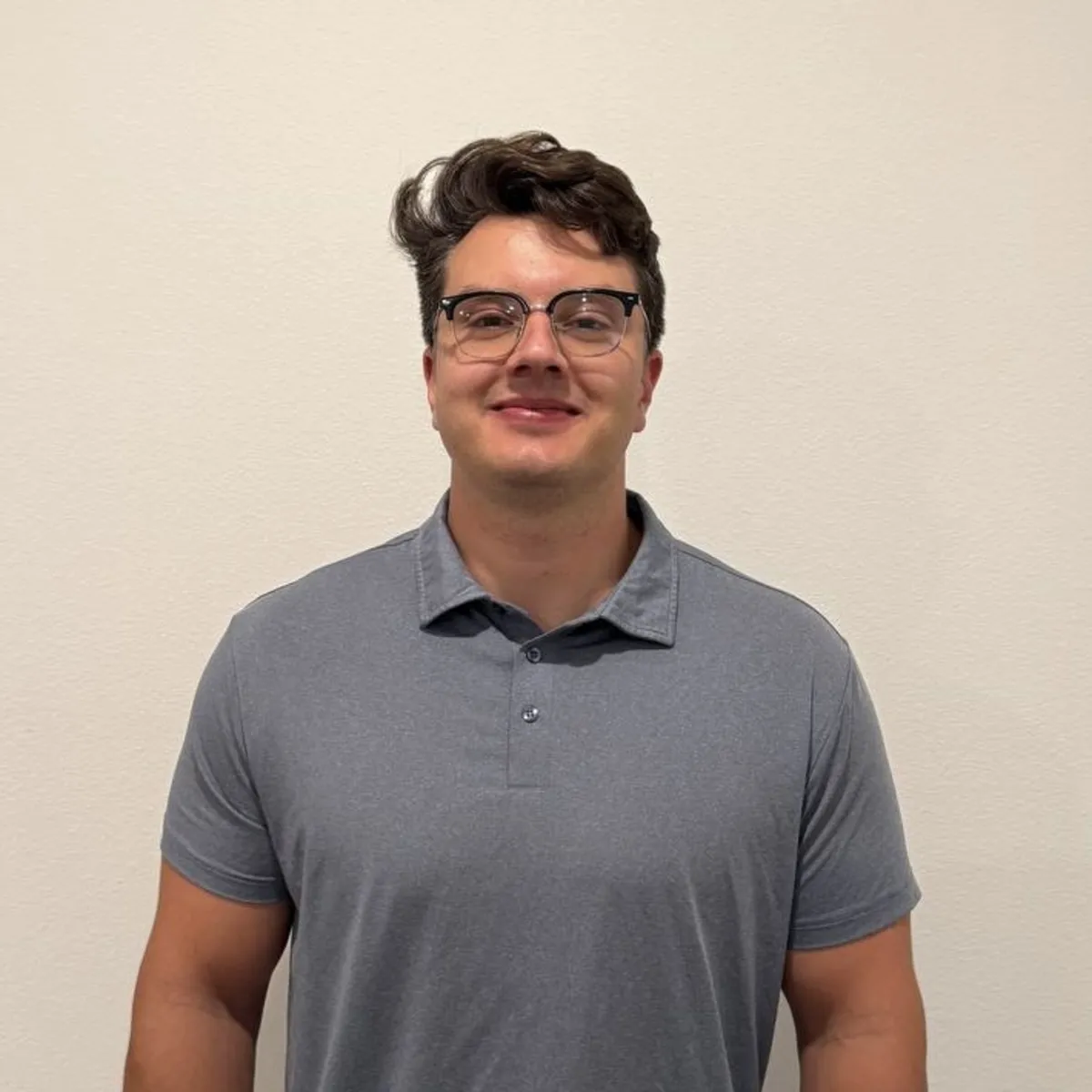
The technicians who show up
Yurii
RefrigerationAndrew
LaundryIgor
KitchenReady When Your Appliance Isn't
Call now or book online — same-day slots across Escondido and North County, 7am–9pm daily. The $80 diagnostic comes off the bill when you approve the repair.