
Technician Alex arrived the same day, which was incredibly convenient. He quickly diagnosed the problem, and to my relief, had the necessary part right in his truck. The repair was completed on the spot, and my fridge was cooling perfectly again by the end of the day. The pricing was fair and affordable.I'm very pleased with the service from Refrigerator and Appliance Repair in Escondido. Alex was a true professional. Highly recommend them for prompt and reliable appliance repair
Freezer Repair in Escondido
Standalone freezers fail quietly. No drama at first — just ice cream that scoops a little too easily, then a smell nobody wants to investigate.

Five Freezer Repairs, Priced Before We Knock
Refrigerator & Appliance Repair – Escondido handles freezer repair in Escondido and the inland North County towns around it: chest, upright, built-in, and drawer units, with same-day visits available daily from 7am to 9pm. The diagnostic costs $80 and counts toward the repair once you approve the work, and every job carries a 90-day labor warranty. We're a family operation, fixing freezers here since 2018. On this page: the five freezer repairs we can price before we knock, six symptoms and their usual causes, a hard look at garage freezers in valley heat, and a food-loss plan for the day one quits anyway. Prefer a human? Call (858) 886-8646. And if the trouble is the freezer compartment inside your fridge, that's a different machine — see our [refrigerator repair](/residential-appliance-repair/refrigerator-repair) page instead.
Most freezer work falls into a handful of jobs, and we'd rather show those numbers now than make you call for them. The ranges below reflect what we charge in North County, sanity-checked against 2025–2026 national repair-cost data. Nothing on our books leaves the shop under $250 — a trained technician, a tested part, and a warranty all cost real money, even on a small fix. Chest freezers tend to land at the low end of each range because access is simple; built-ins land at the top because cabinetry slows everything down.
| Diagnostic visit | $80 — subtracted from the final bill when you approve the work |
| Compressor start relay & overload | from $250 |
| Defrost fault — heater, timer, or defrost stat | $250–$430 |
| Door or lid gasket | $250–$380 |
| Evaporator fan (upright & frost-free models) | $250–$420 |
| Temperature control (thermostat) | $250–$440 |
| Compressor or sealed system | quoted in writing after the diagnostic |
| Condenser fan motor & coil cleaning | $250–$420 |
| Main control board replacement | from $300, written quote after diagnosis |
| Chest-freezer lid hinge & latch repair | from $250 |
These figures are typical ranges for reference only — the exact price comes after the $80 diagnostic, before any work begins, and the price you approve is the price you pay.
Sealed-system and compressor jobs are the exception to the list: they vary too much by model to publish honestly, so you get a written number after we've tested yours — never a guess from the doorway of the garage.
Six Freezer Symptoms and What's Behind Them
Nothing freezes — or only half the box does
Total failure on a standalone unit traces to a short list: a compressor that won't start, a low refrigerant charge, or an evaporator coil buried under ice. Partial freezing tells its own story. In an upright, food that's solid on the bottom shelves but soft up top points to weak airflow — a tired evaporator fan or a frosted coil. In a chest, the walls do the cooling, so a box that's hard at the floor and slushy near the rim usually means the charge has dropped and the compressor no longer has the muscle to chill the whole cavity. We test each link before condemning anything expensive.
A thick coat of frost inside
Frost-free uprights only grow frost when their defrost hardware quits: the heater burns out, the defrost thermostat won't close, or the timer or board never calls the cycle. Ice then builds on the coil until air stops moving and temperatures drift upward. On a manual-defrost chest, frost is part of the deal — but if you chipped it out last month and it's already back, humid air is sneaking past the lid seal. We meter the defrost circuit, replace the dead component, and melt the coil clear so cooling returns fully, not partially.
A click, a pause, another click
That rhythm is the start relay striking out. Its job is to kick the compressor awake; when it weakens, the compressor strains, overheats, trips its overload, rests, and tries again — endless clicking. Sometimes the relay is the entire problem, and it's one of the cheaper fixes on this page. Sometimes the clicking means the compressor itself is seizing and the relay is just taking the blame. An amp reading tells us which, and the difference matters: one answer is $250, the other is a conversation about the freezer's future.
The door or lid won't sit tight
Gaskets harden with age, and garage heat speeds the process. The signs: a chest lid that pops back open, an upright door that needs a hip-check, condensation beading along one edge, or frost concentrated right at the gap. A leaking seal forces long compressor runs, inflates the power bill, and feeds the frost problem above. We stock gaskets for the common Frigidaire, GE, and Whirlpool models, and we can re-hang a sagging door or swap a tired lid hinge in the same visit.
A puddle creeping out from underneath
Meltwater needs a path. When the defrost drain clogs or freezes, every defrost cycle sends water over the edge of its channel instead of down into the pan — and it surfaces as a puddle on the garage floor or a sheet of ice inside the box. A cracked drain pan does the same thing, and on slab-floor garages plain condensation joins the suspect list. We trace the water uphill to its actual source and fix that, so you're not mopping the same spot next month.
It runs around the clock
A healthy freezer cycles: run, rest, run. One that hums nonstop is fighting something — condenser coils blanketed in dust, a gasket bleeding warm air in, a thermostat stuck closed, or an ambient temperature past what the machine was built for. It's the cheapest symptom to ignore and the most expensive to keep ignoring, because the compressor pays the bill. A coil cleaning and seal check often ends it; if not, the diagnostic finds what's really driving the motor.
Garage Freezers in Valley Heat: Chest, Upright, and Honest Limits
Most of the standalone freezers we service in Escondido live in garages, and an Escondido garage is a hard address in summer. By late afternoon an uninsulated garage can run twenty degrees past the air outside. Most standard freezers are rated for ambient temperatures up to roughly 90–110°F; spend a week above that line and the compressor runs continuously, its oil thins, and parts that should last fifteen years age in five. "Garage-ready" models are rated for a wider temperature band — worth checking the sticker before blaming the machine.
Chest or upright for a hot garage? The chest wins, and it isn't close. Cold air is heavy: open a chest lid and the cold mostly stays put, while an upright door spills its coldest air onto the floor every single time. Chest walls carry thicker insulation, and a manual-defrost chest skips the defrost heater entirely — one less component baking out there. A packed chest also holds a couple hundred pounds of frozen mass, and frozen mass is thermal ballast: it flattens the afternoon heat spikes that grind a compressor down.
That ballast is also why a freezer survives a garage that kills a refrigerator. A fridge has to hold its fresh-food section near 37°F behind thinner insulation, with the door opening all day; in a hot garage it cycles itself to death. A freezer guards one deep-frozen block behind thick walls and barely notices the heat wave. If your garage unit is struggling, three things help: give it six inches of breathing room off the wall, keep it away from the west-facing wall if you have the choice, and let us vacuum the condenser while we're out — garage dust chokes a coil about twice as fast as kitchen dust does.
When the Freezer Quits: A Food-Loss Triage
Buying time: the first 48 hours
First rule: leave the lid alone. Every peek spends cold you can't get back. A chest freezer packed full will protect its contents for roughly 48 hours sealed shut. An upright holds less — figure 24 hours when full, and noticeably less when half-empty, because air sheds its cold far faster than frozen food does. If you can do it in one quick motion, push everything into a single tight block; food keeps food cold. Blankets draped over a chest add insulation, and there's no harm in it while the unit is dead anyway. Facing a long wait? Dry ice buys time — the USDA figure is fifty pounds to hold an 18-cubic-foot freezer about two days. Gloves on, garage door cracked for ventilation.
What to refreeze, what to toss
What's safe to refreeze? Use the ice-crystals rule. Any package that still shows ice crystals — or reads 40°F or colder on a thermometer — can be refrozen safely, though texture may take a hit. Raw meat, poultry, and seafood that warmed past that point go in the trash, no exceptions. Bread and plain baked goods are forgiving and refreeze fine even fully thawed. Ice cream is your canary: once it's soup, it's done — and its state is also decent evidence of when the failure started.
Before anything hits the trash, document it. Many homeowner's policies — and most renter's policies — include food-spoilage coverage, commonly a few hundred dollars. Photograph the open freezer with everything still in place, then build an itemized list with rough replacement values as you discard. Hold on to our repair invoice too; it's your proof the loss came from a mechanical failure rather than an unplugged cord. Ten minutes with a phone camera has reimbursed more than one of our customers for the entire repair.
Chest, Upright, Built-In, Drawer — and the Brands on the Van
Chest freezers are the simplest machines we touch: a compressor, a cold control, a lid seal, and walls that do the cooling. Fewest parts, fewest failures, longest lives — plenty of the chests we repair are older than the technician fixing them. Uprights trade that simplicity for shelves and frost-free convenience, which adds a defrost heater, a defrost thermostat, a timer or board, and an evaporator fan; that defrost package is where most upright repairs begin. Built-in column freezers and under-counter drawer units are regular residential work for us too — they just hide behind panels and need extra disassembly time, so mention the model when you book.
On brands, we stay where North County garages and kitchens actually are. Frigidaire and GE built a huge share of the standalone freezers in this valley, with Whirlpool, Kenmore, and Maytag close behind. Samsung and LG dominate the newer uprights, and their electronic controls store fault codes we read during the diagnostic. Whatever the badge, the parts that matter — relays, defrost components, gaskets, fans, cold controls — ride on the van for the common models. Got a different appliance acting up? Our services page lists every machine we repair.
Booking, Diagnosis, Repair — the Short Version
Call (858) 886-8646 or book online. We run daily from 7am to 9pm, and a freezer that has stopped freezing goes to the top of the day's list because the contents are perishable. You'll get an arrival window, plus a text when the van turns toward your street. The visit opens with the $80 diagnostic; approve the repair and that $80 counts toward it. Looking at a second appliance while we're there costs $40 instead of another $80 — one trip, two answers. Start relays, defrost kits, gaskets, fans, and cold controls for the common Frigidaire, GE, Whirlpool, and Kenmore models are already on board, so most freezer repairs finish in a single visit. Everything we fix is backed by the 90-day labor warranty: same fault, same freezer, we come back at no charge.
Escondido Customers on Freezer Repair
Three reviews below, copied word-for-word from our Google profile. Not every one is a freezer call — they're here because they show how a visit with us goes: same-day when we can manage it, a diagnosis you can follow, and the price settled before the work starts.
Amazing and quick job! Washing machine was having problems and he knew how to fix right away! 100% recommend
Yuri came out to fix my non-heating old whirlpool dryer.I took it apart and tried fixing it myself but with no luck. I didn't want to keep throwing money at it.I called one place and they told me they charge $130 just to come look at my dryer. I called this place and they gave me a quote of $80 for diagnostic and possible repair. I thought that was pretty fair. Also I had an appointment the same day I called.Once Yuri showed up, I told him everything I looked for. He took bout 10 minutes to figure out that my gas coils broke. He told me his price, but he told me that i could probably do it myself and he could just charge me the diagnostic fee. I got too many projects to work on so I asked him to fix it. He fixed it in 10 minutes, it probably would have taken me a couple hours because im always scared of breaking things.Fairly priced, fast, and honest
Frequently Asked Questions
How much does freezer repair cost in Escondido?
Plan on $250 to $440 for the common jobs. A start relay begins at $250, door and lid gaskets run $250–$380, defrost repairs $250–$430, evaporator fans $250–$420, and thermostats top out near $440. Compressor and sealed-system work gets a written quote after testing. Every approved repair absorbs the $80 diagnostic, so you never pay it on top.
My garage freezer died during a heat wave — is it worth a service call?
Usually, yes. Heat-wave casualties are often survivable: the typical victim is a start relay or overload protector that failed after days of nonstop running, and that's among the cheaper repairs on this page. We'll also check whether the unit's ambient rating actually suits your garage, and tell you honestly if a garage-ready model is the smarter long-term answer.
How long does food stay frozen when the freezer dies, and what can I refreeze?
A packed chest freezer protects food for roughly 48 hours with the lid shut; an upright is closer to 24, and less when half-empty. Anything still showing ice crystals — or measuring 40°F or below — can be refrozen safely. Raw meat, poultry, and seafood that warmed past that point get tossed, and photographed first if you plan an insurance claim. A few bags of grocery-store ice laid on top stretch either number by several hours.
Can you really get here today?
Most days, yes. We schedule daily, 7am to 9pm, across Escondido and the nearby North County towns, and a dead freezer is treated as a priority because the food can't wait. Call in the morning and same-day is the likely outcome; call in the evening and we'll usually have you first on tomorrow's board.
Chest or upright — which is cheaper to repair?
The chest, almost every time. It has fewer parts to fail and the easiest access in the business. Uprights carry a full frost-free defrost system — heater, defrost stat, timer, fan — which adds failure points, though those repairs still stay in the $250–$430 band. The expensive conversation on either type is the sealed system, which is why that one is quoted in writing only after testing.
Do you work on built-in and drawer freezers?
Yes. Residential built-in columns and under-counter drawer freezers are part of our normal week. They need more disassembly than a garage chest, and panel-front cabinets occasionally take a second set of hands, so give us the model number when you book and we'll schedule the time properly.
The freezer inside my refrigerator is the problem — am I on the right page?
Close, but no. A fridge-freezer shares one cooling system between two compartments and fails in its own particular ways — our refrigerator repair page covers all of that. This page is for standalone units: chest, upright, built-in, and drawer freezers running on their own compressors.
Can you check another appliance during the same visit?
Happily. The first diagnostic is $80; a second appliance inspected on the same visit is diagnosed for $40. Plenty of freezer calls end with us also opening up the dryer or the dishwasher — each machine still gets its own written price and its own 90-day labor warranty.
Brands We Repair
From Samsung and Whirlpool to Sub-Zero and Wolf — we stock parts for every major brand and fix the rest too. Tap yours for repair details and pricing.
No call center, no subcontractors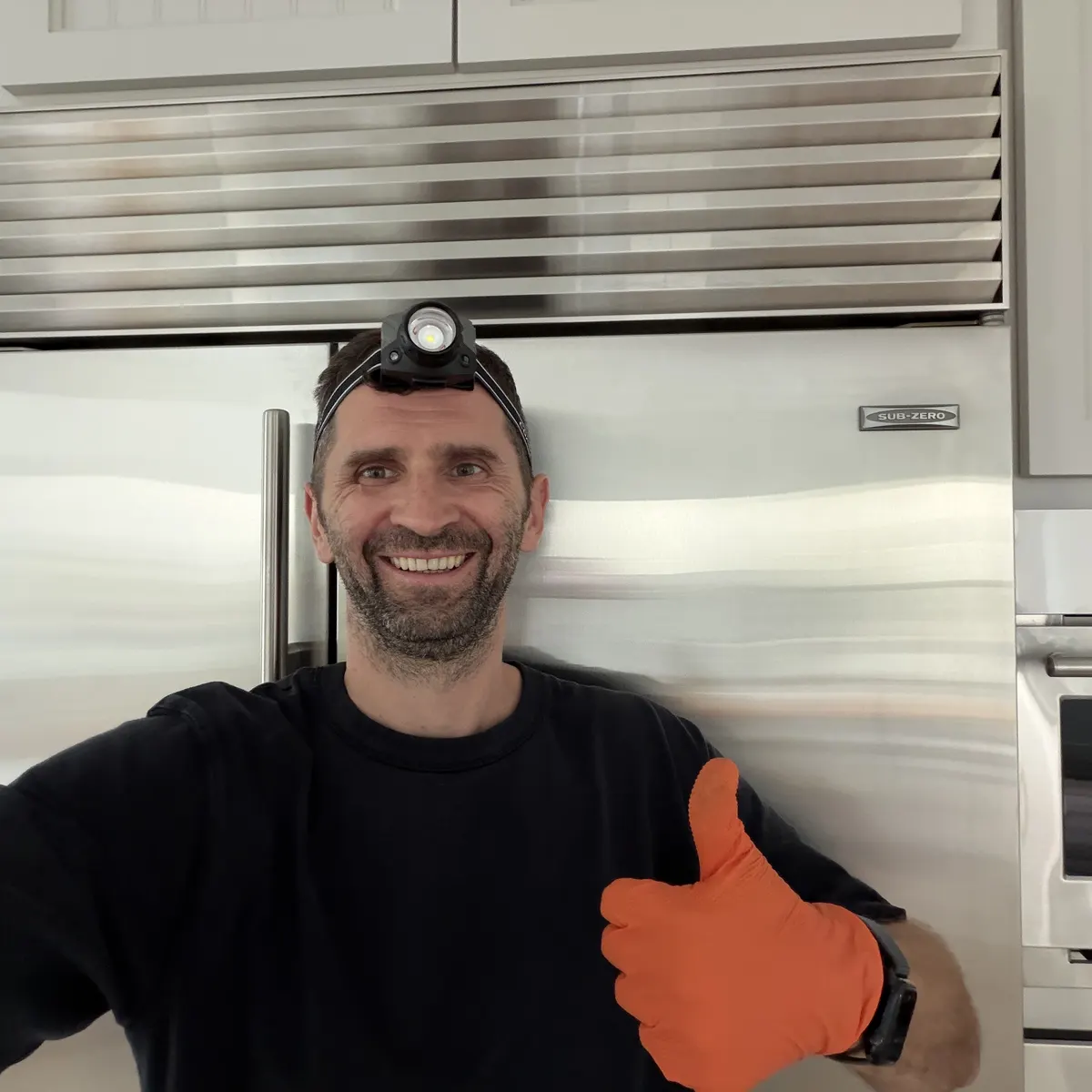


The technicians who show up
Yurii
RefrigerationAndrew
LaundryIgor
KitchenReady When Your Appliance Isn't
Call now or book online — same-day slots across Escondido and North County, 7am–9pm daily. The $80 diagnostic comes off the bill when you approve the repair.