
Samsung Refrigerator Repair in Escondido — Ice Maker Failure on a French-Door Model
The Call
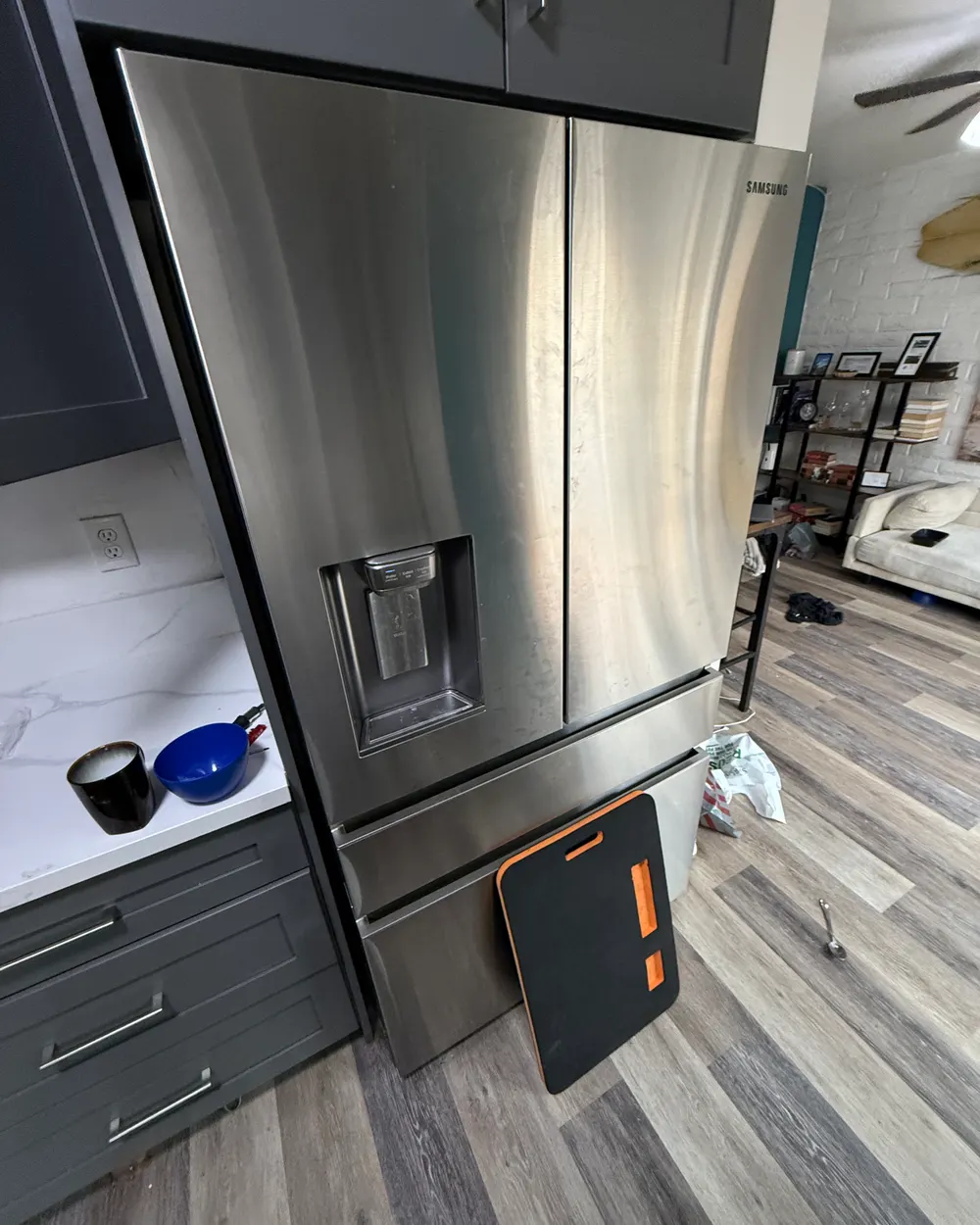
We got a call from an Escondido homeowner on a Wednesday afternoon. Their Samsung RF28R7351SR — a 28-cubic-foot French-door refrigerator with a built-in ice maker — had stopped producing ice about a week earlier. The fridge and freezer were both cooling normally, food was fine, but the ice bin was empty and nothing was coming out when they hit the dispenser.
Samsung ice maker problems are one of the most common repair calls we get in the Escondido area. The RF28R series is a popular model — it's a solid refrigerator overall — but the ice maker assembly has a few weak points that tend to show up between year three and year five. This unit was just past its fourth birthday.
Why Samsung Ice Makers Fail
Samsung's ice maker system uses an auger motor to push ice from the tray into the bin, and then into the dispenser chute. Over time, the auger motor wears out or the ice maker assembly frosts over internally, blocking the mechanism.
There are a few common failure points on these units. First, the auger motor itself can burn out — it's a small motor that runs under load every time you use the dispenser. Second, the defrost drain at the back of the ice maker housing can freeze over, causing ice to build up around the evaporator and eventually block ice production entirely. Third, the ice maker fan can fail, reducing airflow and causing uneven freezing.
The tricky part is that the fridge and freezer will continue cooling normally even when the ice maker is completely dead. That's because the ice maker runs on a separate circuit. So homeowners often wait a week or two before calling, assuming it will fix itself. It won't.
On-Site Diagnosis
Our technician Alex arrived that same afternoon. First step was pulling the ice maker assembly out of the freezer compartment. On the RF28R series, this requires removing a single mounting screw and disconnecting a wiring harness — straightforward if you've done it before, but easy to crack the plastic housing if you force it.
With the assembly out, Alex tested the auger motor with a multimeter. No continuity — the motor windings were open, meaning the motor had burned out completely. This is a definitive test: a good auger motor shows 6–10 ohms of resistance, and this one showed infinite resistance. Dead motor.
Alex also inspected the defrost drain and ice maker housing for ice buildup. There was a moderate amount of frost around the evaporator cover, but not enough to be the primary cause. The frost was a secondary effect of the auger not cycling — when ice sits without being moved, moisture accumulates and freezes in place.
The Repair
We carry Samsung ice maker auger motors on our service vehicles because this is such a frequent repair. The replacement took about 40 minutes:
- Disconnected power to the refrigerator at the wall outlet.
- Removed the ice bin and ice maker assembly.
- Swapped the burned-out auger motor for a new OEM Samsung part.
- Cleared the frost buildup from the evaporator housing using a steamer — never use a heat gun on plastic Samsung parts, it warps them.
- Reinstalled the assembly, reconnected the wiring harness, and powered the unit back on.
- Ran a forced ice maker test cycle using Samsung's diagnostic mode (hold the ice maker button for 8 seconds) to confirm the new motor was engaging properly.
Within 90 minutes the ice maker had completed its first full cycle and was dumping ice into the bin. We told the homeowner to give it 24 hours to fill the bin completely, but the unit was working correctly before we left.
How to Tell Your Samsung Ice Maker Needs Repair
Before calling anyone, here are the signs that point to a hardware failure rather than a simple reset:
- The ice bin is empty and has been for more than three days.
- No unusual noises from the freezer — this actually suggests the motor isn't even trying to run.
- You've already tried the reset button (small button on the side of the ice maker — press and hold for 10 seconds) and nothing changed.
- The freezer temperature is at or below 0°F — ruling out a temperature issue.
If all four of those check out, you likely have a component failure. The auger motor is the most common cause, followed by the ice maker fan motor and the defrost drain. A diagnostic visit will tell you exactly which one.
Case Summary
| Appliance | Samsung RF28R7351SR (French-door refrigerator) |
| Problem | Ice maker not producing ice — burned-out auger motor |
| Warranty | 90-day guarantee on parts and labor |
| Time on-site | Under 2 hours |
| Solution | OEM auger motor replacement + evaporator defrost |
Experiencing a similar Samsung ice maker issue?
Our technicians carry OEM Samsung parts and can usually complete the repair same-day.
Flat $80 diagnostic credited toward the repair · 90-day guarantee
Open 7am to 9pm, every day
Call Now: (858) 886-8646 —
Frequently Asked Questions
Why did my Samsung ice maker stop working while the fridge still cools fine?
The ice maker runs on its own circuit, so the fridge and freezer keep cooling normally even when the ice maker is completely dead. On the RF28R series the usual failure points are a burned-out auger motor, a frosted-over evaporator caused by a blocked defrost drain, or a failed ice maker fan. A no-continuity reading on the auger motor confirms it has burned out. Because the fridge still works, homeowners often wait too long — the ice maker will not fix itself.
Should I keep using the ice maker reset button?
Pressing and holding the reset button on the side of the ice maker for about ten seconds is worth one try, since it clears minor glitches. If the bin stays empty for more than three days afterward, you are looking at a hardware failure rather than a software hiccup. A burned-out auger motor is the most common cause, followed by the fan motor and the defrost drain. At that point a diagnostic visit will pinpoint exactly which part needs replacing.
How long does a Samsung ice maker repair take?
Replacing a burned-out auger motor typically takes under an hour on-site, and we carry these motors on the vehicle because the repair is so common in the Escondido area. After the new motor is installed we run a forced test cycle to confirm it engages. The ice maker usually completes its first batch within 90 minutes, though it takes about 24 hours to fully refill the bin.
What does a Samsung refrigerator diagnostic cost in Escondido?
The diagnostic is a flat $80 and is credited toward the repair if you approve the work. The technician tests the auger motor, fan, and defrost system on-site so you get a definite answer. Every repair includes a 90-day guarantee on parts and labor, and we use OEM Samsung parts. Call (858) 886-8646 or book online to save $20 — we are open any day, 7am–9pm.
Walked Through It and It Still Won't Cooperate?
Some fixes need a meter, a part, and a second pair of hands. Call us or book online — the $80 diagnostic comes off the bill when you approve the repair.